
Lean Management is…
Lean management is generally derived from the Toyota Production System. Lean is the elimination of waste. But, more importantly, lean is continuous improvement in all work processes. If someone tells you that lean management is this and not something else, if someone puts it in a box and ties a bow around it and presents it in a neat package with four walls around it, then that someone knows not of what they speak. Why? Because it is in motion and not a framed picture hanging on the wall. It is a melody, a rhythm, and not a single note.
Lean management was developed by Taiichi Ohno, Shigeo Shingo and others over a forty year period. It began with efforts to reduce die change time on the stamping press which then allowed for a reduction of in-process inventory and this became just-in-time inventory management. This resulted in the need for less warehouse space, fewer forklifts, unnecessary space, etc. Once the flow of work can be interruption free, free of materials sitting, standing, and redo-loops, waste is eliminated. Lean is the elimination of waste. But, more importantly, lean is continuous improvement in all work processes. 
In order to improve the work of the die press and reduce waste Shingo did not instruct the workers. He asked the workers to think. He challenged them to innovate and find ways to speed the process by eliminating unnecessary activities. The workers who operated the press and changed dies worked as a team and together they solved problems and sought improvement. It was the front line workers, who were on-the-spot, and who were truly the world’s greatest experts in their work, who experimented, watched the data, and learned from the facts.
The Essence of Lean is Continuous Improvement
This model of improving the work process by those who do the work, by those who are on-the-spot, is the essence of lean management. The model of Shingo asking the work team to think, to experiment, and to learn from the data, is the model of lean management. It is management that is humble and not arrogant. It is management that observes, encourages, challenges, and learns. It is management that gathers the facts, encourages experimentation, and spreads best practices. It is management that practices what they preach to others. This model was quickly copied by Honda and other Japanese companies and has now become the standard of world class manufacturing. And, it has become the standard for management in all types of work settings. Lean is a moving target because, at its heart, lean is a process of learning and improvement. It cannot be defined as something that is standing still or fixed. It is not simply mimicking what happened at Toyota or anywhere else. And, most importantly, it is not a kaizen event, a project, or something done by a consultant. It is best captured as a philosophy rather than a particular method or technique. If you don’t have the philosophy, you don’t get it.
Lean Leadership | The House of Lean
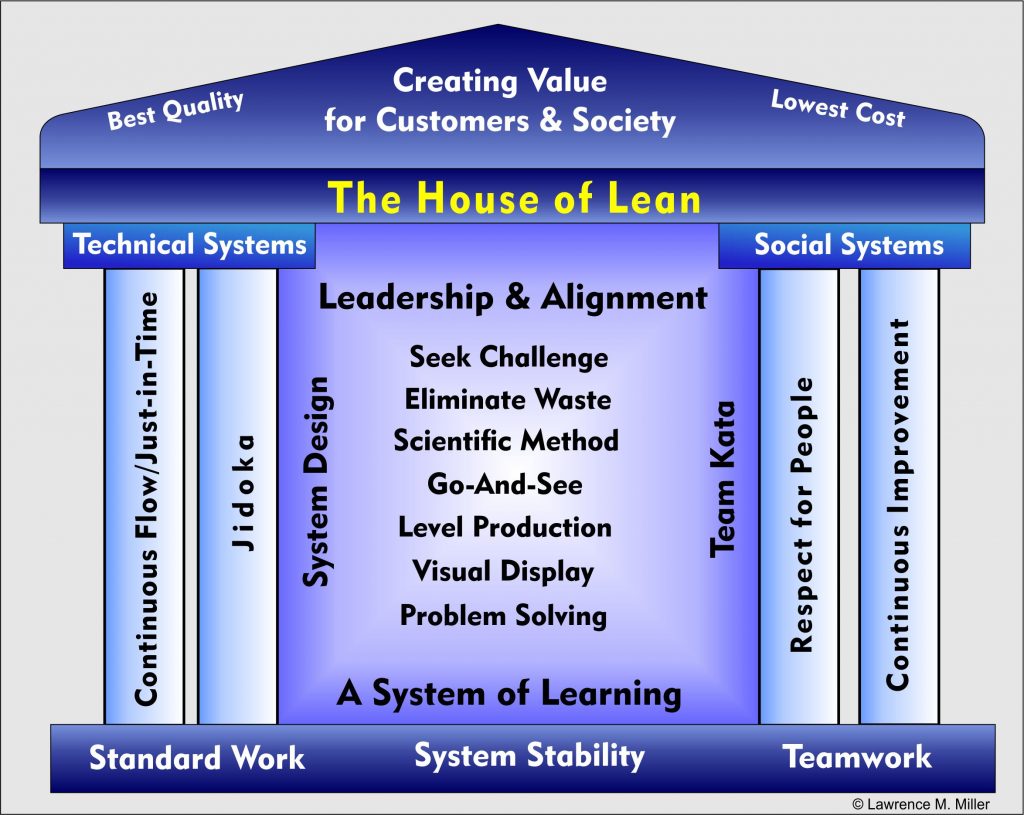 This “House of Lean” describes the key components of lean management. These include both the technical aspects of lean and the social or cultural aspects of lean. My course on Lean Leadership, Lean Culture, and Change Management describes each of these components and the two critical paths to change: the design of the lean system and the development of new habits, the “Team Kata” that establishes a new pattern of continuous improvement.
Here are some ways of describing lean philosophy or culture:
-
- Lean is a culture of continuous improvement practiced at every level of the organization and by every team.
- Lean is the application of the scientific method of experimentation and study of work processes and systems to find improvements.
- Lean is respect for people. It is respect for the voice of the customer and it is respect for those who do the work, who are “on-the-spot” and are, therefore, the “world’s greatest experts” in their work.
- Lean is the elimination of waste in all its forms. Lean is the ability to distinguish between work that actually adds value to your customers and work that does not. By eliminating waste, you free resources to devote to value-adding activity that serves your customers.
- Lean is a work environment that assures the quality and safety of all work for both customers and staff.
- Lean is a focus on improving the work process and not on blaming people or creating fear.
- Lean is a culture of teamwork, shared responsibility and ownership that cuts through organization walls or silos.
- Lean is a culture that returns the joy to work. Honda speaks of the three joys of buying, selling and making the product. We do our best work when we have joy in our work.
- Lean is flow. Lean is an interruption free process that flows from beginning to end without interruption.
There are many aspects to the technical side of improving the work flow. These may include Kanbans, Poke-A-Yoke, continuous line flow, the arrangement of suppliers to customers, etc. There are both technical and social system elements to lean. This author’s primary focus is on engaging both managers and employees in a culture of continuous improvement, while redesigning both whole-system of the organization. Within lean management are the lessons learned from generations of experimentation in management. The work of Frederick Taylor and Henry Ford are not dismissed, but incorporated and built upon. All of the work in industrial and organizational psychology are incorporated. The work of Dr. W. Edwards Deming, Shewhart and Juran are incorporated. The work of Fred Emery and Eric Trist who founded the school of socio-technical systems is integral to the nature of lean organization. Toyota alone, did not invent good management. Toyota and Honda simply did a superior job of learning and applying the lessons to which many others contributed. Your job is to incorporate these lessons within your own management system and to seek improvement… continuously. My job is to help you.
Lean Management Principles
Here are three lectures on the Principles of Lean Management which are part of my course on Team Leadership.
Lean Principles 1
Lean Principles 2
Lean Principles 3
Five stars! for Lean Leadership & Lean Culture
“The way Larry conveys the message is amazing! Such a great course, with so much knowledge and practical experience added! I would recommend this course to EVERYONE!” Brendan McHugh, Udemy Business
“A very good presenter, communicates very clearly and understandably (even for me, and I don’t speak perfect English and usually don’t understand everything). I’m glad I paid for this course – I feel it was worth it. Thank you!” Zsolt Dienes
“Explains things very well! Seems very interested in his students. Also, he is really passionate about what he teaches and does a very good job.” Lela Lofgren, Udemy Business