

Congress and The Continuous Lack of Improvement in Behavior
Now, I generally try to avoid dabbling in divisive politics, but this one time I can’t resist. We have all been following the fiscal cliff dance in Washington. As I write, the task of coming up with a way around the cliff has been delegated to those two great charismatic leaders of the Senate – Harry Reid and Mitch McConnell, which I know inspires confidence in all.

Last night President Obama made the statement that This is déjà vu all over again. Outside of Washington, nobody understands how it is that this seems to be a repeat pattern. Referring, of course, to the tendency of Congress, with two years warning and anticipation, to wait until the last hour to do anything constructive.
Well, with all due respect, Mr. President, that is not exactly correct. For you see, this is a phenomena that is well known in every freshman dorm, and by every pigeon or mouse that has been subjected to behavioral research.


B.F Skinner and his Skinner Box
Let me explain in its simplest form. There is something called “schedules of reinforcement” which is the study of how the timing of positive reinforcement effects behavior. Within that, there is something called a fixed-interval schedule. Very simply, a monthly pay check, an annual bonus, the end of a semester in college, a test at the end of the month, etc., are all fixed intervals. The reward is delivered at the end of the time period. When on such a schedule the pattern of behavior is entirely predictable. The pigeon or mouse learns that there isn’t much payoff in performing during the early part of the period, but as the end of the period approaches, the rate of behavior increases. After the reinforcement (the cheese, for example) is delivered, the mouse or pigeon pauses – what’s called a “post-reinforcement-pause.” This pattern is seen as a “scallop.”
Here’s what happens when there is an end-of-month bonus for the number of cars sold by auto salesman, for example.
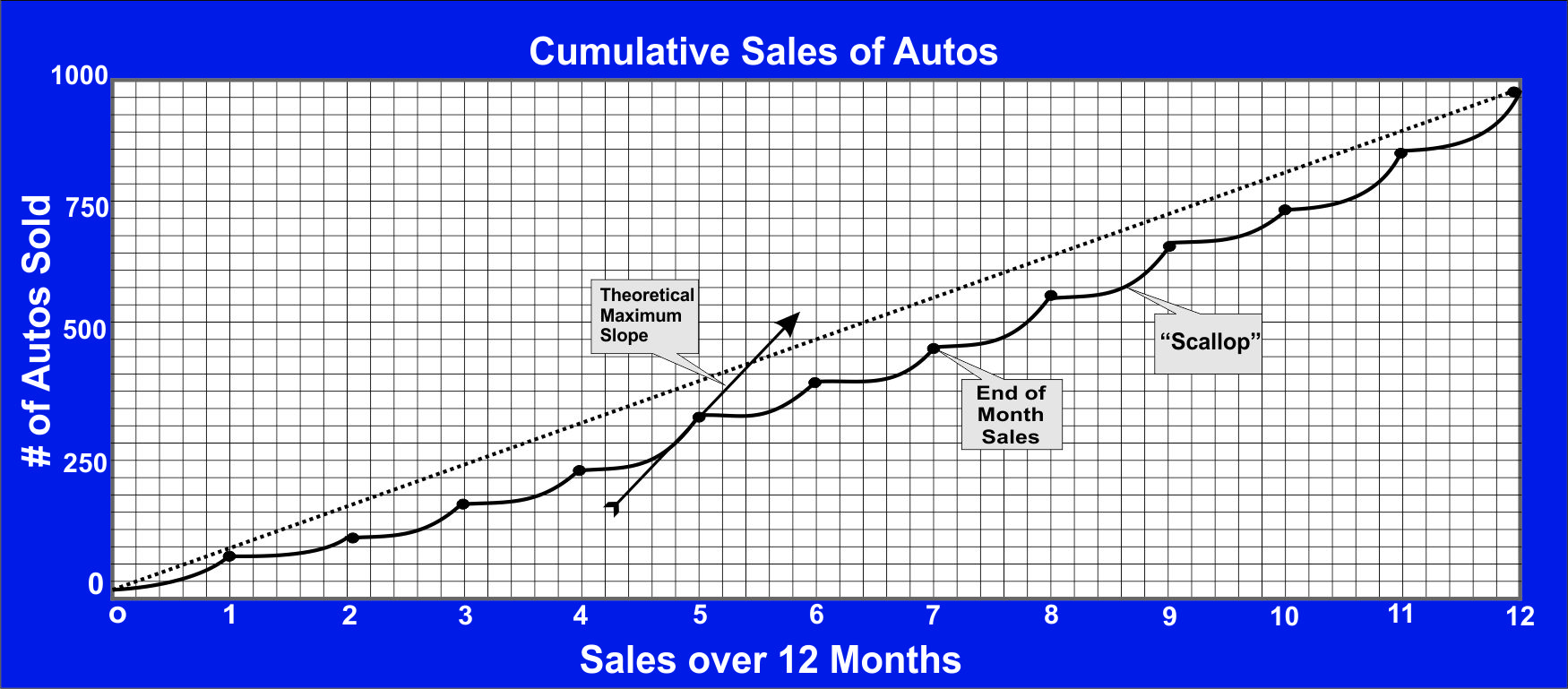
Now, I couldn’t possibly be implying that students at Harvard, in high school, or the brilliant, motivated and charismatic leaders we elect to Congress are no better than a pigeon pecking away for measly pellets in a Skinner box. Of course, not. We are intelligent and we all knew in the freshman dorm that if we studied our history lessons each night throughout the semester we would not have to cram for the test the night before. Right? Wrong! We all did it. When it comes to overcoming the effect of schedules of reinforcement we are not much better than pigeons.
The next time you are in a casino and look out at all those good folks pulling the one armed bandit realize that you are looking at a huge Skinner box in which a party of pigeons are pecking away on a variable-ratio schedule of reinforcement which produces addictive and high rate behavior. Trust me, there are behavioral psychologists plotting the data and manipulating the schedule of reinforcement!


So, the behavior of our charismatic leaders of the accounting firm Read, McConnell, Boehner and Pelosi are doing exactly what the system predicts. In fact, every year, there are very few bills passed during the first weeks of a session of Congress and bills tend to fly through during the closing days. That’s your scallop.
So, how do you fix this? How do you get students to study more consistently? How do you get sales persons to sell throughout the month rather than offering “great deals” at the end of the month? If you are the manager of a sales organization, how do you optimize the total number of units sold, rather than creating the post-reinforcement-pause during which the salespeople relax? And, how do you get Congress to behave as rational adults rather than as immature mice?
Of Mice and Men and Motivation
There are a few possible answers to this dilemma. And they all must, in some form, change the way Congress people are rewarded or punished for their behavior. Plans, talk, slogans, ideologies, etc. will do no more good with Congress than with pigeons.
First, our friends in Congress receive compensation, retirement benefits, healthcare, vacations, expense allowances, etc., with absolutely no contingency to performance. In other words, every student gets an “A” without studying, every salesman gets the top bonus without selling any cars, and every mouse gets the cheese without moving. This is the essential problem with communism. The absence of contingency between behavior and reinforcement. We all know that this will produce delinquent behavior. So, there must be a link to performance and pay-off. The absence of this link is why congress gets a 9% approval rating. That’s about the same rating we would give to communism as an efficient economic system and for the same reasons.
So, how can we link rewards to congressional performance? Here are a few suggestions:
- Start by cutting all fixed compensation and allowances by 30% and make earning the previous amount, plus an additional 30% on a scale based on improvement in the budget deficit. In other words, at zero deficit they would earn the baseline amount. Any deficit would result in a corresponding reduction in compensation, and any surplus would result in an amount above baseline. So… balancing the budget would payoff in a very personal way. This would cut through ideology. Business people don’t sit around having loud and nonsensical debates about whether it is better to increase revenue or reduce expenses to achieve a balanced budget. They do both to create a positive margin. And, executives shouldn’t get bonuses when they are losing money!
- Every newspaper and television station in the Congress person’s district should publish weekly (short interval), the number of hours congress was in session and the number of hours the congress person was on the floor in attendance. In other words, they should do their “standard work.” We don’t reward students for not attending school, why should we reward our representatives for not attending to their work? Short interval reinforcement schedules result in more consistent behavior and a net gain in performance (a daily quiz in school will produce greater learning than an end-of-month test).
- There should be a balanced scorecard. In other words, financial measures of performance are not the only important measures, and that is true whether for Congress or your own managers. What else is important? How about measures of future competitiveness such as the math and science scores of our students? How about the ratio of imports to exports? How about reductions in violence within our society? Each of these can be measured and it is the job of our leaders to have a positive impact on these. Why not put aside some percent of total compensation for all of our representatives (maybe the President, also) and dispense that based on net decreases in violence, increases in math and science scores, and increases in rates of innovation, exports, etc. In other words, a balanced scorecard that would pay-off.
I know some will read this and say “Good heavens, man! We elect these people because we think they are responsible, mature, and good leaders. Do we really need a system of positive reinforcement that rewards actual performance?” I understand the objection. But, the data speaks! What does it tell you? Or, as B. F. Skinner used to say to his students “The pigeon is never wrong!”
OK, so there are some ideas from me. What are yours? No ideological rants, please. It’s not about ideology, it is about management!