

Lean Training
The problem for most organizations developing lean management is two fold: first, how to change the culture in a significant way, in a reasonable period; and second, how to provide the needed training to a large number of people in a consistent and quality manner.
Team Leadership – The Kata of High Performance is an effort to solve both of those problems. Self-paced online learning is the answer. The course is now available for a very low price, $50. The accompanying book, Team Kata, is now available in my Amazon store. The intention is that team members and team leaders, both natural work teams and management teams, go through the online learning and are then assisted by an internal coach. The coach focuses on helping the teams do the “deliverables” that are suggest with each section. It is an action-learning model – learn, do, receive feedback, learn more, do, etc.
I recommend that the course be a six month to one year curriculum for teams. While going through the course they will develop a scorecard, interview their customers, map their work process, eliminate waste and variances, learn three problem solving models, develop standard work, and solve human performance problems, and develop facilitation and listening skills. It will create change through real world experience.

The Kata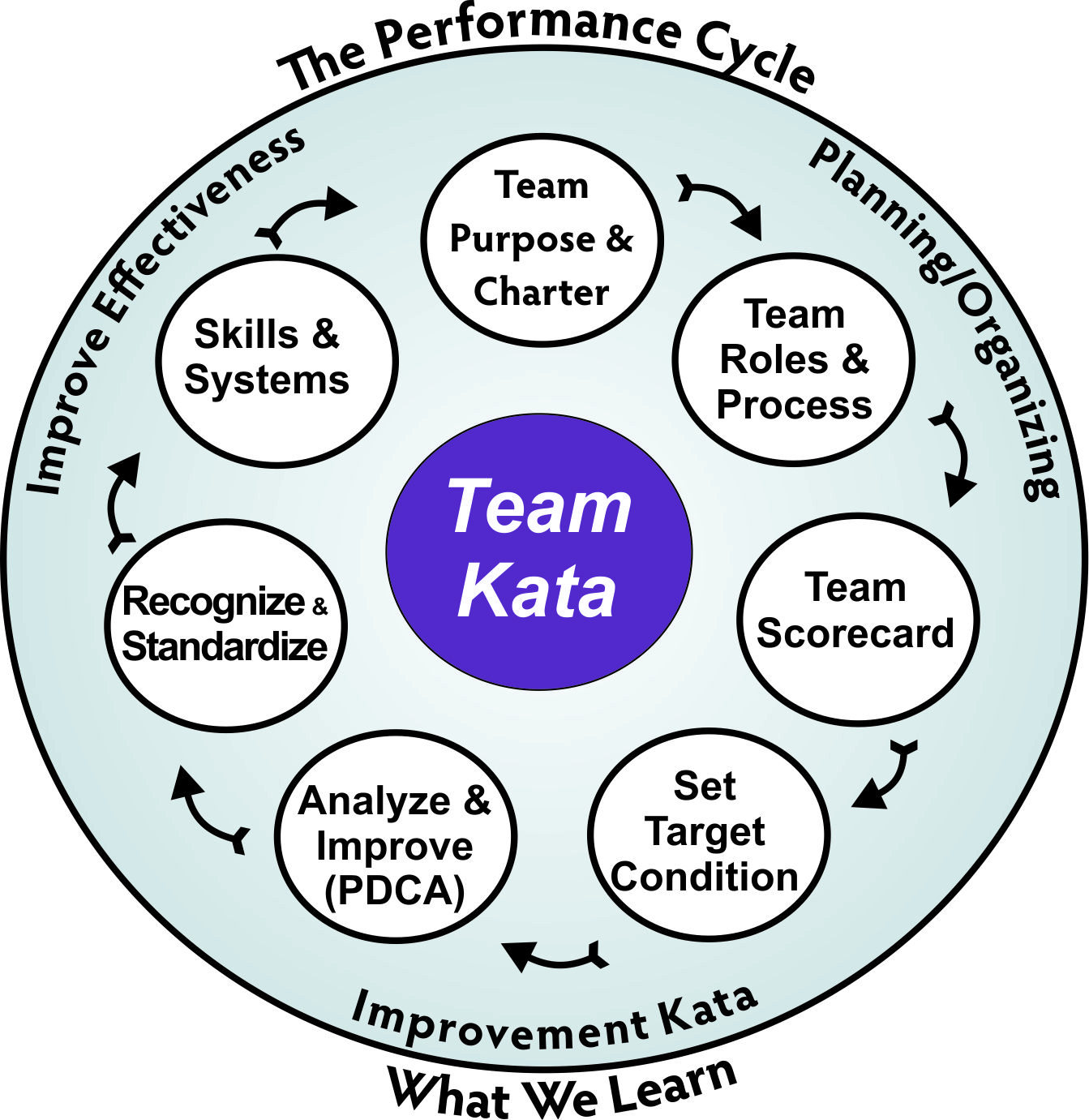

A “kata” is a routine of practice that results in the building of skills. The word is most commonly used in karate, however Mike Rother in his book Toyota Kata has brought the word to management attention. What I have taught for many years is a discipline approach to practicing the skills of effective teamwork, team management, and problem solving – in other words, a Team Kata.
The first section of the course focus on organizing the team, establishing a charter with roles, responsibilities and process definition.
The second section is the Improvement Kata, gathering the facts of performance, interviewing customers, setting targets and gradually moving from the current state to an ideal future state through continuous problem solving and experimentation.
The third stage is to standardize the team practices, methods proven successful through experimentation, and developing the skills of team facilitation and interpersonal communication.
There is a lot of material in the course and students or teams may skip around, go back to sessions as needed, and use attached materials.
I will be continuously improving the course as I receive feedback (from you?) from my customers. I hope you will take a look.
The Curriculum
Section 1: Introduction
- Lecture 1: Team Leadership – Introduction
- Lecture 2: The Curriculum & Coaching Map
Section 2: Principles of Lean Management
- Lecture 3: The Beginning of Lean
- Lecture 4: Lean Self-Assessment
- Lecture 5: Principles of Lean Management – 1
- Lecture 6: Principles of Lean Management – 2
- Lecture 7: Principles of Lean Management – 3
- Quiz 1: Principles of Lean Management
- Lecture 8: A Brief History of Work Systems
- Quiz 2: A Brief History of Work Systems
Section 3: The Coaching Kata
- Lecture 9: The Coaching Kata – The Process
- Lecture 10: The Coaching Kata – Example
- Quiz 3: The Coaching Kata
Section 4: Writing Your Team’s Charter
- Lecture 11: Defining Your Team
- Quiz 4: Defining Your Team
- Lecture 12: Writing Your Team’s Charter
- Quiz 5: Writing Your Team’s Charter
- Lecture 13: Coaching Tips
Section 5: Getting Organized
- Lecture 14: Getting Organized
- Lecture 15: The Agenda
- Quiz 6: Getting Organized
Section 6: Stages of Team and Organization Development
- Lecture 16: Stages of Team Development
- Lecture 17: Life Cycles of Organizations
- Quiz 7: Stages of Team Development
Section 7: Clarifying Decision Styles
- Lecture 18: Clarifying Decision Styles
- Lecture 19: How to Reach Consensus
- Quiz 8: Clarifying Decision Styles
Section 8: Developing Your Team Scorecard
- Lecture 20: The Improvement Kata
- Quiz 9: The Improvement Kata
- Lecture 21: Developing Your Team Scorecard
- Lecture 22: The Balanced Scorecard
- Quiz 10: Developing Your Team Scorecard
- Lecture 23: Targets, Goals and Objectives
- Lecture 24: MBO & Self-Control
Section 9: Defining Customer Requirements
- Lecture 25: Defining Customer Requirements & Improvement Targets
- Lecture 26: The Customer Interview
- Quiz 11: Defining Customer Requirements
Section 10: Solving Problems
- Lecture 27: Introduction to Problem Solving
- Lecture 28: Healthy Attitudes of Problem Solving
- Lecture 29: Situation Analysis
- Lecture 30: Root Cause Analysis – The 5 Why’s
- Lecture 31: Brainstorming Causes
- Lecture 32: PDCA Problem Solving
- Quiz 12: Problem Solving Basics
- Lecture 33: A3 Thinking
- Lecture 34: Steps in A3 Problem Solving
- Lecture 35: The Skill of Brainstorming
- Lecture 36: Pareto Analysis
- Lecture 37: Action Planning
- Quiz 13: A3 Problem Solving
Section 11: Mapping Your Value Stream
- Lecture 38: Mapping Your Value Stream
- Lecture 39: Work Process & Relationship Maps
- Lecture 40: Steps in the Process
- Quiz 14: Mapping Your Value Stream
Section 12: Analyzing Variances in Your Process
- Lecture 41: Understanding Variances and Variability
- Lecture 42: Variance Analysis
- Quiz 15: Analyzing Variances
Section 13: Finding and Eliminating Waste from Your Process
- Lecture 43: Eliminating Waste
- Lecture 44: Management Waste
- Quiz 16: Eliminating Waste
Section 14: Motivation and Human Performance
- Lecture 45: The Hierarchy of Motivation
- Lecture 46: The Power of Purpose – The Soul of Our Work
- Quiz 17: The Hierarchy of Motivation
- Lecture 47: Social Motivation and the Radius of Trust
- Lecture 48: Situational Motivation – The ABC’s
- Lecture 49: Situational Motivation – Why it Works
- Quiz 18: Social and Situational Motivation
- Lecture 50: Lean Culture and Motivation
- Lecture 51: Fact Based Definitions
- Lecture 52: Types of Positive Reinforcement
- Quiz 19: The Science of Behavior Management-1
- Lecture 53: Keys to Intrinsic Motivation
- Lecture 54: Schedules of Reinforcement
- Lecture 55: Analyzing Human Performance Problems
- Lecture 56: Modeling and Appreciative Inquiry
- Lecture 57: Reducing Poor Performance – To Punish or Not?
- Quiz 20: The Science of Behavior Management-2
Section 15: Standard Work and Leader Standard Work
- Lecture 58: Developing Standard Work
- Quiz 21: Standard Work
Section 16: Team Facilitation Skills
- Lecture 59: Introduction to Team Facilitation
- Lecture 60: The Eight Skills: Organizing & Clarifying
- Lecture 61: Motivating, Comforting & Controlling
- Lecture 62: Concluding a Topic or Meeting
- Lecture 63: Resolving Conflicts within the Team
- Quiz 22: Team Facilitation Skills
- Lecture 64: Using Virtual Technology
- Lecture 65: Virtual Facilitation – Pre Work
- Lecture 66: Eleven Tips for Great Virtual Meetings
Section 17: Effective Listening Skills
- Lecture 67: Body Language
- Lecture 68: Asking Effective Questions
- Lecture 69: Empathy and Active Listening
- Lecture 70: Acknowledging and Using Silence
- Quiz 23: Listening Skills
Section 18: Giving and Receiving Feedback
- Lecture 71: Straight Talk – A Model for Giving Feedback
- Lecture 72: Straight Talk – A Model for Receiving Feedback
Section 19: Improving Team Dynamics
- Lecture 73: Exercises for Improving Team Dynamics
Section 20: Improving the System
- Lecture 74: Introduction to Improving the System
- Lecture 75: Models of Organizational Systems
- Lecture 76: Whole System Architecture
- Quiz 24: Improving the System
Thanks,
Larry Miller

